
John Maeda Speaks at Creative Mornings Session
In TheStar.com’s 2010 article “CEOs Must Be Artists?”, McGill University Professor and artist Nancy Adler spoke of “a tradition of hostility between the arts and commerce,” in which “artists, too often, think of businesspeople as Philistines, and [businesspeople], in turn, think of artists as a bit flaky.”
Last Friday at the monthly breakfast lecture series “Creative Mornings,” guest speaker and current President of RISD (Rhode Island School of Design), John Maeda, endeavored to explain to his audience that, not only can artists and designers make great leaders/CEOs, but that the business world in general could benefit immensely from using the same techniques and mindset with which artists and designers approach their work.
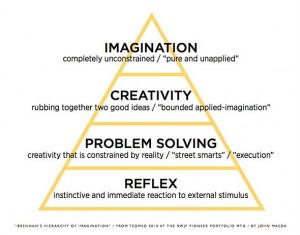 Maeda described one of these approaches as “taking leaps.” Employing a pyramid visual taken from Dr. Patricia Brennan of the University of Wisconsin-Madison’s work, Maeda argued that your archetypal businessperson in a role of leadership is stuck on the lower two rungs of the pyramid, where all decision-making is constrained by reality. Artists and designers, he argues, move beyond that realm into higher plane of problem solving which involves creativity, and finally “boundless creativity,” or, imagination. As artists and designers, we are constantly striving to create a solution that is unique to the world. As Adler puts it: “You’d be hard pressed to find a painter who didn’t approach a blank canvas wanting to produce something of high quality, but all too often people in the commercial world end up settling for the just-good-enough.”
Maeda’s bottom line? It is time that art and design stopped being thought of as “optional” but as a viable and essential part of the future of American education and business.
 Susannah Hainley is a graphic designer for Red Rooster Group, a New York based graphic design firm that creates effective brands, websites and marketing campaigns for nonprofits to increase their visibility, fundraising and communications effectiveness. Contact us at info@redroostergroup.com.


