Branding and Religion Butt Heads

Design and Religion Butt Heads
Where does the sanctity of religion leave off and branding begin? That’s the question that Sikh transit workers are addressing in their protest against the MTA requirement that they wear the agency’s logo on their turbans.
The issue underscores the importance of design in today’s society and the extent to which we identify and legitimize people’s role through their uniforms. At what point does the perception and authority of the MTA as an agency, or the individual employees become undermined by not wearing part of a uniform? Another MTA concern would be where to draw the line on people claiming an exception to the rule .
While a proponent of the benefits that design can confer, I think it abhorrent that the MTA would seek to desecrate a religious item with an organizational logo. Apparently, I am not alone, as 27 City Council members signed on to a letter of support, urging Transit President Howard Roberts to drop the logo rule adopted after 9/11, when four Muslim women were barred from driving buses while wearing head scarves.
Nonetheless, as religious expressions expands and the hand of branding reaches into ever-increasing areas of our life, from our food, to our clothing, shelter, transportation and entertainment, there will no doubt be more conflicts in retaining “authentic,” unbranded versions of these things. I think the larger lesson is that while we can all appreciate the positive attributes branding brings, we must also be sensitive to its limitations.

Where does the sanctity of religion leave off and branding begin? That’s the question that Sikh transit workers are addressing in their protest against the MTA requirement that they wear the agency’s logo on their turbans.

Continue reading

Lessons from an Outreach Campaign

Lessons from a Campaign – Blog Post
I recently followed up with an nonprofit organization that produced an outreach campaign around the concept of alleviating hunger in their community. Taking a three-pronged approach of collecting food, soliciting donations, and galvanizing people to long-term volunteering, the organization partnered with other community groups to implement the campaign. Ambitious and well-intentioned as it was, the campaign did not achieve their desired outcome. Here’s what they learned.
Lessons
1. Focus on one goal. Raising $100,000, collecting food and inspiring volunteerism turned out to be too many goals for one initiative and spread them too thin. They said that next time, they would assess what is realistic and focus and channel their efforts toward that one  goal.
2. Allow enough time. With only three months to coordinate the effort, they were already short of time in coordinating all parties, lining up the right assistance and developing the marketing. Allow 6 to 12 months to work out the strategy, plan the details, galvanize support.
3. Have strong leadership. In this case, they had the laudable goal of stitching together a coalition of community groups. However in practice, there were too many chefs in the kitchen and disputes broke out about who was in charge. Strong, diplomatic leadership is needed as well as clearly articulated roles for each party that match their expertise and meet their interests.
4. Plan properly. Lack of proper planning resulted in major problems, such as not getting the requisite permission in time to distribute 140,000 flyers in schools – a huge wasted opportunity – as well as a website that was incapable of collecting volunteers names. Proper planning can help you to map the roles, responsibilities and logistics, as well as contingency plans, needed for a successful campaign.
5. The coordinator who was hired to recruit volunteers did a good job in his initial outreach, but failed to set up a campaign office to field calls. As a result, innumerable volunteers were lost and the effectiveness of the overall campaign was compromised. There are several possible lessons from this:
A. Vet your consultants thoroughly to ensure that they have the necessary expertise and capabilities to deliver on what they say they can.
B. Fully understand the scope of services that you are engaging them in and document it in writing.
C. Assign one person to take responsibility and provide proper oversight, including feedback, support, resources and monitoring to ensure the project is on track.
6. Identify your weakness and get help. The organization recognized that they lacked the expertise or connections to get media exposure for their campaign. Looking internally they found someone with a contact to a former TV reporter who was very connected to the media. They got him to volunteer his services, which proved invalable in getting media coverage.
7. Build the structures needed to ensure continuity. For this campaign, one of the goals was to inspire people in the community to become regular volunteers. Poor planning and oversight resulted in a website that did not capture volunteers names or list the ongoing volunteering opportunities with the community groups. Had this been a priority, the campaign could leveraged this asset to build on the hundreds of hours of work put into the campaign.
8. Learn from your mistakes and build on your relationships.  Unfortunately, the relationships with the community partners were left in a more strained status than at the start. Bringing together other organizations to work on a campaign serving the public interest is a good foundation from which to grow. And while success is the goal, some mistakes are inevitable. Viewed as learning experiences, these could be seen as opportunities for all parties to gain knowledge about what does work and to deepen their relationships for future collaborations.
•   •   •
Postscript: In the end, the organization publicly claimed the campaign as a success, stating that it was billed as a one time event, raising 2,000 pounds of food (and justifying that it did raise the $100,000, but from community foundations that had made previous pledges, instead of the public as intended).

A nonprofit organization produced an outreach campaign around the concept of alleviating hunger in their community. Taking a three-pronged approach of collecting food, soliciting donations, and galvanizing people to long-term volunteering, the organization partnered with other community groups to implement the campaign. Ambitious and well-intentioned as it was, the campaign did not achieve their desired outcome. Here’s what they learned.

Continue reading

Staying Creative: Watercolors from Fire Island

Careful observation is the key to strategic thinking and to staying creative. Instead of relying solely on the computer, I stay fresh through drawing and painting which enhance my observation skills, nurtures my appreciation for nature, and provides time to reflect. Here are some watercolors from my recent four day trip to Fire Island. Enjoy…

Two trees on the bay side of Davis Park, Fire Island, the most remote community – peaceful – with nothing to do but paint.Continue reading

Nonprofit & Green Events


Looking for good networking? Check out these event calendars:

NONPROFIT

Charity Happenings – A large list of fundraising events, galas and benefits produced by nonprofits

Nonprofit Central – Good list of events and workshops for nonpofit professionals around the NY tri-state area

New York Council of Nonprofits – Events sponsored by NYCON

NYCON – New York Council of Nonprofits (based in Albany, NY) – list of their own workshops

United Way of Westchester & Putnam Counties, NY – list of events by nonprofits in those counties

The Long Island Way – Portal for connecting nonprofits and businesses in Long Island.


ENVIRONMENTAL & CORPORATE RESPONSIBILITY

Environmental Business Association of New York State – (based in Albany, NY) – list of their own workshops

CSR Wire – Corporate Social Responsibility Network: CSR-related events nationally

Green Biz – Business. The Environment. The Bottom Line.: CSR-related events nationally

Green-Links.org– Green events and resources around NYC


Red Rooster Group IconRed Rooster Group is a New York based graphic design firm that creates effective brands, websites, and marketing campaigns to increase your visibility, fundraising, and communications effectiveness. Contact us at info@redroostergroup.com.


Seminar on Fundraising Events

Toady, I conducted a seminar on Branding and Your Fundraising Event in conjunction with Peter Levinson, Owner of Levinson Block LLC. The session was part of the Connecticut Association of Nonprofits’ spring education series.

Held in New Haven, CT, the workshop helped nonprofits understand how to marry their mission with their fundraising event so that event attendees would leave the event as advocates for the organization. Using case studies for a house salon party, walk-a-thon, dinner gala, and conference-type events, we explained how an organization’s brand can inform the look of the marketing materials for the event, how to highlight the organization’s name so that donors know what event they are supporting, and ways to maximize your marketing budget,

A Few Takeaways:

  • Create a theme for your event that reinforces your mission.
  • Employ graphic techniques for establishing a consistent visual look for allmarketing materials for the event – from the invitation, to the journal, the emails, as well as the signs and presentation at the event.
  • Look for every opportunity to promote your mission and create a consistent brand.
  • Have your speakers reinforce your mission as part of the theme of their speech.
  • And don’t forget a podium sign with your logo!

The seminar can be adapted for different audiences and different lengths. To bring this session to your organization, contact Howard Levy at 212-673-9353 or howard@redroostergroup.com.

RRG Speaker Ad 3


Red Rooster Group IconRed Rooster Group is a New York based graphic design firm that creates effective brands, websites, and marketing campaigns to increase your visibility, fundraising, and communications effectiveness. Contact us at info@redroostergroup.com.


Fail Fast: How to Inspire Innovation

How do you foster innovation in your organization? Well, most organizations are more worried about making mistakes than the potential upside benefit. So the key in managing your mistakes.
Rita McGrath, Professor, Columbia Business School gives this advice: Recognize that you can’t measure the rate of failure, but you can manage the cost, so manage the cost. You can have a lot of failures if they are cheap. In short: fail cheaply.
And these days you can fail more cheaply than ever before, so it’s a good time to push the boundaries and explore new ground, whether it’s in developing new services, finding new funding methods, launching new fundraising events, exploring partnerships or collaborations or getting your feet wet in social media.
And if your effort doesn’t work out, learn from it and apply it to your next step.
But when you fail in your pursuit of progress, take note of the lessons. Think of it like tuition – You paid the tuition, so benefit from it. Recognize things you have learned that can make you more competitive in your core mission or can be by someone else.
WAKE UP CALL: Are you willing to create a new measurement of success for your organization? One that can take on new challenges, fail fast, cheap and move on, measuring your success by the amount of learning, willingness to grow, progress toward a goal and willingness to stop and move on to something else.
Resource: www.youtube.com/watch?v=M-91LvoyAZo&feature=channel

How do you foster innovation in your organization? Most organizations are more worried about making mistakes than the potential upside benefit. So the key is in taking the initiative, and managing your mistakes.

Rita McGrath, Professor, Columbia Business School gives this advice: Recognize that you can’t measure the rate of failure, but you can manage the cost, so manage the cost of your mistakes and benefit from them. You can have a lot of failures if they are cheap. In short: fail cheaply.Continue reading

White House Launches New Social-Innovation Office

Picture of the White HouseThe new White House Office of Social Innovation and Civic Participation was created without much fanfare. In fact, even though it has been operating for several months, it has never been formally unveiled.
But the office, set up to promote creative and effective ways to tackle social problems, is slowly starting to emerge as a public entity. The White House briefly outlined its goals in a statement last month to announce that the president was proposing $50-million in his 2010 budget for a social-innovation fund. And after months of working behind the scenes, White House officials have started to speak publicly about the office’s plan

The Obama Administration is moving quickly to support the public sector and foster public-private partnerships that foster innovation.

The new White House Office of Social Innovation and Civic Participation,set up to promote creative and effective ways to tackle social problems, is slowly starting to emerge as a public entity. The White House briefly outlined its goals in a statement last month to announce that the president was proposing $50-million in his 2010 budget for a social-innovation fund. And after months of working behind the scenes, White House officials have started to speak publicly about the office’s plan. Read the full article at the Chronicle of Philanthropy.

FivePoints Compliance Brochure

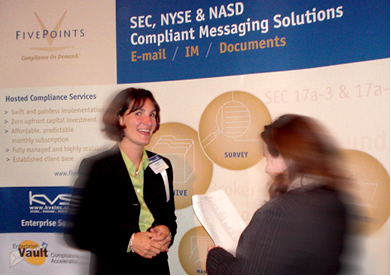
We developed the branding, brochure, folder and collateral to successfully launch this technology company which provides email compliance services for the financial sector. We also developed their trade show booth, advertising and other marketing materials.

FivePoints Display


Links