Assessing Your Nonprofit Brand

How well do your donors know your organization? In large part that depends upon how well you are communicating your brand — your vision, values and personality. If done well, you can form deep and lasting bonds with your donors. If not, you risk confusing your audience. In a short-attention span world, organizations that are able to quickly communicate their value are the ones that attract the most overall support. This article focuses on how you can evaluate your brand and marketing communications.

Continue reading

The Role of Vision in Nonprofit Marketing & Communications

How your nonprofit can communicate its mission for greater impact

By Howard Adam Levy, Principal, Red Rooster Group


How does your nonprofit organization remain relevant? By keeping your strategic focus on what’s important. While many nonprofits understand the importance of strategic planning, making sure that the organization’s vision is communicated to donors, clients another constituents is another matter. This article, published in Nonprofit Advantage, the quarterly publication of the Connecticut Association of Nonprofits, describes the different between an organization’s vision, brand and marketing, so that you can improve your overall communications and fundraising strategies.


Vision, Brand, and Marketing

You need to have a vision in order to be relevant and inspire donors. A vision bold and audacious enough to inspire people to action around your mission, realistic enough to be believable and measureable.

A nonprofit needs to tell people what it stands for and what it wants to accomplish, what promises it will make to its stakeholders – both clients and donors – and how it will go about keeping those promises.

That’s its vision.

Vison takes into account new ways of accomplishing your mission. It takes into account:

  • trends in the sector
  • economic issues
  • demographic changes
  • new business models, including partnering and collaboration
  • new ways of giving, such as online campaigns
  • combining advocacy with services in order to be more effective in solving social problems.

Vision is great, but if no one knows about it, it’s inconsequential.

Your organization’s brand is its reputation for keeping the promises it made and living up to its vision. A brand is more than a logo or a color scheme: It is how your agency is viewed by the public as a result of what it stand for and what its done. Your brand is what you stand for. So if you have done a good job conveying your vision, people will have an accurate perception about your organization.

That’s your brand.

Marketing is the extent to which you have a say over what people think; it includes what you say and how you say it.

Your marketing and communications plan is integral to fundraising efforts. It’s the message that prompts a response from foundations, individual donors, volunteers, community and political leaders, and clients. You want that response to be positive. A recognized, well-presented, strong brand will support your fundraising efforts by:

  • Attracting donors;
  • Improving community relations
  • Improving the effectiveness of advocacy efforts for your issue
  • Positioning your organization as a leader in your sector (as a valuable source of knowledge, information, and connections).

Combined, your vision, brand, and marketing help people understand and value what you do. And that is the foundation for the long-term success of your organization.

Now that we understand how vision, brand, and marketing work together, let’s take a look at each component.

Defining Your Vision

The best way to define your vision is through a strategic planning process that starts from the bottom — line staff, clients — and works its way up the board. During this process, the organization will:

  • Define its mission, which may have changed from its founding;
  • Identify the programs that further its mission and those that do not;
  • Develop a plan to implement its mission (possibly a redefined one) in the future.

When you’ve decided who you are and what you stand for, you have to develop a succinct way to communicate that vision. You need a brand and a marketing plan.

Creating Your Brand

To reach the people you need to reach — donors, volunteers, community leaders, referring agencies — you have to have a distinct brand. To do so, you need to know the target audiences, the ways in which they access information, and the visual representation — logo, tagline, colors — that will evoke their interest and commitment.

You have to do research both inside and outside the organization. If you’ve already done a strategic plan that clearly delineated your vision, you’re part way there. Now you have to think not just of the clients you serve and how you want to serve them but to the community in which you work and the donors you seek to attract.

You’ll have to think about what media to use and what words, colors, and graphics will be most meaningful and effective for each audience and in each media.

Staff, board members and clients can all contribute to this research but you’ll also need to go outside the agency. Are there other nonprofits who offer the same services you do? What is their brand? How is it presented? Is any organization already using the words or graphics that you’re considering?

So many questions! But the answers will determine how you present your brand — your vision and reputation — effectively, in a way that will generate trust in your organization and encourage support from donors, volunteers, government agencies, and volunteers.

Marketing Your Vision and Brand

The marketing plan defines how, when, and with what resources your organization will use to communicate its key message about the problem it is addressing and the unique and effective way in which it is doing so.

The marketing plan also includes accountability: who is responsible for each part of the plan, a schedule of actions to be taken, and a means of tracking expenses and effectiveness of each aspect of the plan.

A good marketing plan will:

  • Convey your organization’s unique vision
  • Establish a system to ensure consistency across all forms of communications including internal materials, website, and newsletters
  • Lay out the most cost-effect way to produce materials, whether in-house or through outside vendors
  • Raise the level of professionalism of your organization’s marketing materials;
  • Provide a foundation for growth and ongoing marketing by strengthening your organizational capacity

At every point of contact with all stakeholders — website, newsletter, email, social media, printed material — you must convey your vision, not just your services. It’s your vision, not your services, that will inspire donors, staff, and clients to engage and support your organization.

Vision and marketing are inextricably linked. If you don’t market your brand — that vision of who you are and where you are going — you’re winking in the dark: Nobody knows what you are doing and no one is going to care if you need money.


Howard Adam Levy is the principal of Red Rooster Group, branding, marketing and design firm based in New York City serving nonprofits nationwide. Red Rooster Group helps nonprofit organizations to improve their visibility, communications and fundraising efforts by developing effective strategy, websites, email campaigns and other forms of marketing outreach. For help improving your brand, contact: info@redroostergroup.com.


This article was originally published in Nonprofit Advantage, the quarterly publication of the Connecticut Association of Nonprofits.


LINKS


Updated Brand Unifies Social Service Organization with 3 Locations


Grafton Featured Image

CLIENT: Grafton

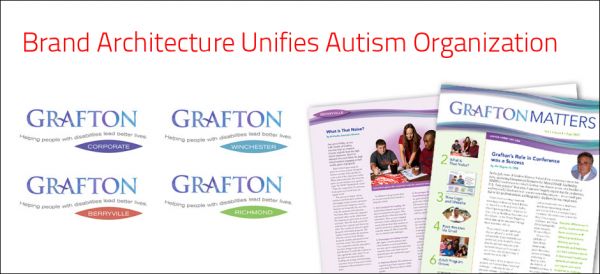
Providing services for people with a range of mental disabilities including autism, Grafton School was perceived as the last resource for help. With three locations in Virginia, the organization was calling out to be rebranded as a regional powerhouse in behavioral healthcare. Red Rooster Group repositioned Grafton as a centralized source for hope in the Mid-Atlantic region. We updated an old tagline and introduced a new visual look.

Brand Architecture

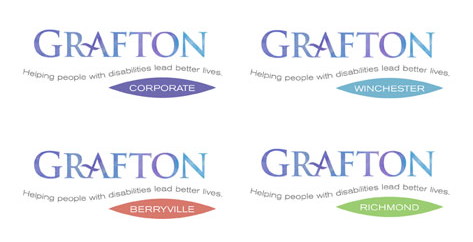
Our research uncovered that one of Grafton’s strengths, the specialized expertise and dedication of its staff, was not being conveyed. We shortened the official name of Grafton School to Grafton and established a brand hierarchy to unify the organization’s four locations under one brand name.

Grafton Logo

Grafton Logos


Brand Manual

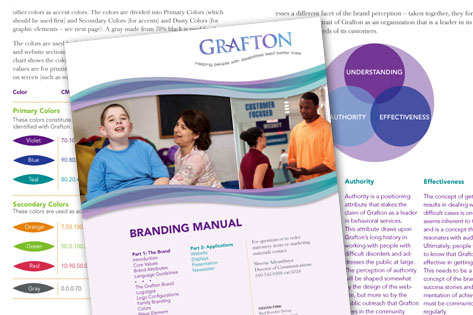
We created a brand manual to explain the brand – what the organization stands for — and specifies colors, typefaces, graphics  and guidelines for the brand. This has allowed the client manage their own brand effectively.

Grafton Brand Manual


Website

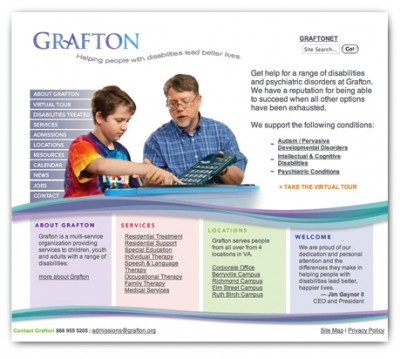
After a strategic assessment of competitors and the users, we redesigned the website around the needs of the users. The redesign has been receiving rave reviews. grafton.org

Grafton Website


Newsletter

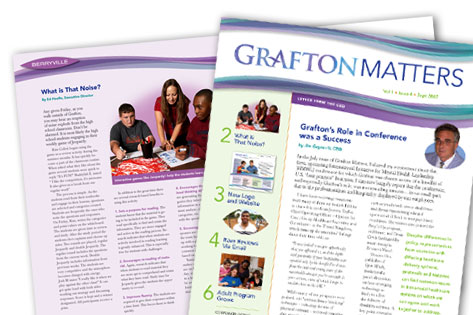
Grafton’s internal newsletter to its 700 employees at their three locations keeps employees informed and generates enthusiasm for the organization.

Grafton Newsletter


Display

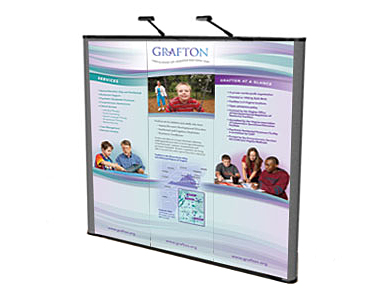
A flexible system of interchangeable panels helps make their display adaptable for fairs, attracting potential students and employees.


10 Ways of Expressing Your Nonprofit Brand

Here are 10 ways that you can use to express your brand. These concepts are taken from a seminar I conducted on business and nonprofit branding at the Brooklyn Creative League.

1.  Through a celebrity, personality or spokesperson that embodies your vision. Jimmy Carter has been bringing credence and visibility to Habitat for Humanity since 1984.

2.  Through a tagline that inspires people to action. United Negro College Fund’s slogan was created in 1972 and has since become of the most famous taglines of all brands in the business and nonprofit sectors.

3. Through a consistent drumbeat of advertising that conveys your message in a memorable way. The Energizer Bunny has been racking up sales since 1989 through print and broadcast ads that have become iconic.

4. Through dramatic images that evoke human emotion. Save the Children, Feed the Children and other relief organizations have used images of starving children to stir the heart and appeal to human conscience, compassion and guilt to such an extent that these images have lost some of their effect.

5. Through a consistent use of color and symbol that becomes linked to your cause. Susan G. Komen for the Cure put breast cancer research on the map through their walks involving thousands, and have co-opted the color pink and the pink ribbon to symbolize breast cancer.

6. Through innovation that drives demand for your products or services. Apple consistently sets new standards with breakthroughs in the personal computers, portable music, and phones, as well as new methods that buck the industry, such as charging for individual song downloads.

7. Through a new business model that focuses on customer needs. The Doe Fund took homeless people off the street, trained them for a job and created an enterprise that generates revenue – solving social problems with a profit.

8. By being first with an idea to become a leader in your sector. Toyota launched the Prius in 1997, making it the first mass-produced hybrid vehicle and became a leader in both sales and caché.

9. Through a character that makes a serious message palatable. Smokey Bear’s message, “Only You Can Prevent Forest Fires,” was created in 1944 and has become engrained in our national conscience.

10. Through dramatic action that captures the attention of the media. Greenpeace’s precision focus on a key message delivered dramatically (not always legally) at the right time and place has been a winning formula for keeping the pressure on decision-makers.

WAKE UP CALL: How many of these techniques are  you using to convey your nonprofit brand?

What Makes a Top Nonprofit Brand?

It is interesting to note that these organizations are nearly a hundred years old (some even older), with the exception of Habitat which is 33 years old and ARC, which is 60 years old. During that time, there was less competition and these organizations’ missions were unique.
Today, there are approximately 950,000 nonprofit organizations registered in the United States, many with competing missions. It is more important than ever for nonprofits to establish strong brands in order to break through the clutter and attract donors and be successful as organizations.
Large organizations have the resources to maintain a strong brand presence, but smaller organizations can be successful by making managing their brand a strategic objective.
Ways to build a strong nonprofit brand include having:
– A clarity of mission. – A focus on impact achieved, not just services. – Consistency in delivering results. – Marketing that is donor- and member-centric, rather than organization-centric. – Contemporary, relevant design that engages donors. – Communications that respects members and donors and allows for two-way communications. – Brand guidelines and brand infrastructure to maintain your brand. – Staff and board act as brand ambassadors and can articulate the organization’s mission and impact. To learn more about building a successful nonrprofit brand, visit blog.redroostergroup.com and redroostergroup.co

The top nonprofit brands in the United States are recognizable names and were selected because of their size, strength of brand image, geographic reach, revenue, and propensity for growth, according to branding agency Cone. The Top Ten Nonprofits in the United States are:

  1. YMCA of the USA
  2. The Salvation Army
  3. United Way of America
  4. American Red Cross
  5. Goodwill Industries International
  6. Catholic Charities USA
  7. Habitat for Humanity International
  8. American Cancer Society
  9. The Arc of the United States
  10. Boys & Girls Club of America

Continue reading