
How can your nonprofit organization stand out and create a breakthrough brand? This article describes three key ingredients.
Continue readingHow can your nonprofit organization stand out and create a breakthrough brand? This article describes three key ingredients.
Continue reading
I think it is amazing the power that a company’s name has. It is also amazing how changing a company’s name can really change the business it is getting. Do you think that the risk of losing a part of your customer base to gain more customers is worth a name change?
Continue reading

Join us for a a free panel discussion on developing your organization’s fundraising capacity. This session brings together 3 points of view about what it takes to succeed in today’s economy. Learn about key fundraising take-aways on the state of fundraising with the Giving USA report on philanthropic trends, learn about the importance of building your nonprofit’s brand and positioning your organization for success, and the role of planned giving programs as an essential part of your fundraising strategy. This crucial session combines big picture thinking with tactical ideas to impact your 2011 fundraising program.
Full description of Free Fundraising Panel Discussion.

How can two young teachers, fresh off stints from Teach for America, create what has become one of the most successful models for a charter school in America? Work Hard. Be Nice. is the story of hard work, persistence, and above all, a deep-rooted commitment to helping kids in the face of an educational system that denies has written them off.
Continue reading
Nonprofits seek to improve their websites for many reasons:
These were the key points I made at our Websites That Work seminar at the United Way of Westchester yesterday. The 3-hour session helped nonprofits to understand the essential steps in the website process which include:
Download a PDF of the Websites That Work presentation
Contact us if you need help in reviving your website: 212-673-9353 or howard@redroostergroup.com
 Red Rooster Group is a New York based graphic design firm that creates effective brands, websites, and marketing campaigns to increase your visibility, fundraising, and communications effectiveness. Contact us at info@redroostergroup.com.

As part of our commitment to the nonprofit sector, Red Rooster Group is proud to sponsor and promote the New Jersey Center for Non-Profits’ conference.
Red Rooster Group is providing naming, branding and promotional services for the conference including development of the theme, conference logo, and design of postcards, posters, and website graphics.
Titled, Ready, Set Recover: Succeeding in the New Landscape, theme is intended to convey the practical nature the sessions, with hands-on advice that nonprofits can use to improve their organizations.
The Conference will bring together nonprofits in the state to gain insight into big picture issues and learn practical tactics for improving their organizations. Sessions will address the issues of accountability, advocacy, boards of the future, collaboration, human resources, marketing, media, and technology.
The conference will be held on December 9, 2009 at the Crowne Plaza Monroe / Jamesburg, NJ. Other sponsors include JPMorgan Chase & Co., Novartis, Prudential, Bank of America, Mercadien Group and Nonprofit Central.

Learn how to effectively brand your business and gain a competitive advantage with this hour and half workshop.

Redesigned website gives nonprofit a professional look.
Continue reading
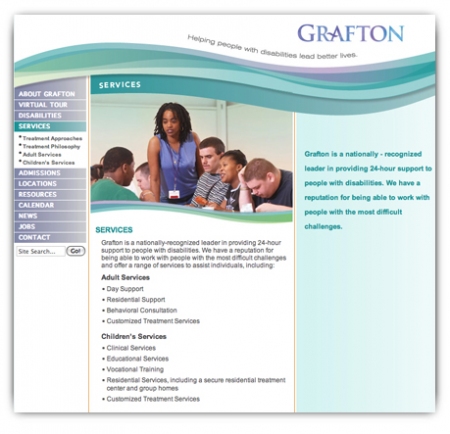
This site for a behavioral healthcare organization serving people with autism and other cognitive and mental disorders was part of a complete brand overhaul that we did for the organization.
We upgraded Grafton’s brand to make it more relevant, designed their website, and created their newsletter and a modular display system to attract clients and employees.
We designed the site to appeal to both potential clients as well as referral sources. It features a virtual tour, full information and photos on each location, an admissions section with PDFs of all necessary forms, an art gallery and other resources. The site has almost 100 photos, which we retouched to coordinate with the colors in each section. The nonprofit website is built with a content management system (CMS) to allow the client to update content. The site has proved very successful with their 300 employees as well as their clients.
Red Rooster Group is a New York based graphic design firm that creates effective brands, websites and marketing campaigns for nonprofits and businesses to increase visibility and awareness and improve fundraising and advocacy effectiveness. Contact us at info@redroostergroup.com.

How well do your donors know your organization? In large part that depends upon how well you are communicating your brand — your vision, values and personality. If done well, you can form deep and lasting bonds with your donors. If not, you risk confusing your audience. In a short-attention span world, organizations that are able to quickly communicate their value are the ones that attract the most overall support. This article focuses on how you can evaluate your brand and marketing communications.
Continue reading
By Howard Adam Levy, Principal, Red Rooster Group
You need to have a vision in order to be relevant and inspire donors. A vision bold and audacious enough to inspire people to action around your mission, realistic enough to be believable and measureable.
A nonprofit needs to tell people what it stands for and what it wants to accomplish, what promises it will make to its stakeholders – both clients and donors – and how it will go about keeping those promises.
That’s its vision.
Vison takes into account new ways of accomplishing your mission. It takes into account:
Vision is great, but if no one knows about it, it’s inconsequential.
Your organization’s brand is its reputation for keeping the promises it made and living up to its vision. A brand is more than a logo or a color scheme: It is how your agency is viewed by the public as a result of what it stand for and what its done. Your brand is what you stand for. So if you have done a good job conveying your vision, people will have an accurate perception about your organization.
That’s your brand.
Marketing is the extent to which you have a say over what people think; it includes what you say and how you say it.
Your marketing and communications plan is integral to fundraising efforts. It’s the message that prompts a response from foundations, individual donors, volunteers, community and political leaders, and clients. You want that response to be positive. A recognized, well-presented, strong brand will support your fundraising efforts by:
Combined, your vision, brand, and marketing help people understand and value what you do. And that is the foundation for the long-term success of your organization.
Now that we understand how vision, brand, and marketing work together, let’s take a look at each component.
The best way to define your vision is through a strategic planning process that starts from the bottom — line staff, clients — and works its way up the board. During this process, the organization will:
When you’ve decided who you are and what you stand for, you have to develop a succinct way to communicate that vision. You need a brand and a marketing plan.
To reach the people you need to reach — donors, volunteers, community leaders, referring agencies — you have to have a distinct brand. To do so, you need to know the target audiences, the ways in which they access information, and the visual representation — logo, tagline, colors — that will evoke their interest and commitment.
You have to do research both inside and outside the organization. If you’ve already done a strategic plan that clearly delineated your vision, you’re part way there. Now you have to think not just of the clients you serve and how you want to serve them but to the community in which you work and the donors you seek to attract.
You’ll have to think about what media to use and what words, colors, and graphics will be most meaningful and effective for each audience and in each media.
Staff, board members and clients can all contribute to this research but you’ll also need to go outside the agency. Are there other nonprofits who offer the same services you do? What is their brand? How is it presented? Is any organization already using the words or graphics that you’re considering?
So many questions! But the answers will determine how you present your brand — your vision and reputation — effectively, in a way that will generate trust in your organization and encourage support from donors, volunteers, government agencies, and volunteers.
The marketing plan defines how, when, and with what resources your organization will use to communicate its key message about the problem it is addressing and the unique and effective way in which it is doing so.
The marketing plan also includes accountability: who is responsible for each part of the plan, a schedule of actions to be taken, and a means of tracking expenses and effectiveness of each aspect of the plan.
A good marketing plan will:
At every point of contact with all stakeholders — website, newsletter, email, social media, printed material — you must convey your vision, not just your services. It’s your vision, not your services, that will inspire donors, staff, and clients to engage and support your organization.
Vision and marketing are inextricably linked. If you don’t market your brand — that vision of who you are and where you are going — you’re winking in the dark: Nobody knows what you are doing and no one is going to care if you need money.
Howard Adam Levy is the principal of Red Rooster Group, branding, marketing and design firm based in New York City serving nonprofits nationwide. Red Rooster Group helps nonprofit organizations to improve their visibility, communications and fundraising efforts by developing effective strategy, websites, email campaigns and other forms of marketing outreach. For help improving your brand, contact: info@redroostergroup.com.
This article was originally published in Nonprofit Advantage, the quarterly publication of the Connecticut Association of Nonprofits.