3 Tips to Use Donor Data to Improve Nonprofit Storytelling

3 Tips to Use Donor Data to Improve Nonprofit Storytelling

Throughout the course of managing your nonprofit’s donors, you likely gather a lot of information about them. Your donor data is a treasure trove of insights about the individuals who power your nonprofit’s mission.

In addition to supporting your fundraising, relationship-building, and prospect research efforts, did you know donor data can also play a supporting role in nonprofit storytelling? Donor data can help you tell more impactful stories and tailor your storytelling to each donor’s preferences.

In this guide, we’ll explore these three tips for using donor data to enhance your storytelling efforts: 

  1. Incorporate data into your impact stories.
  2. Use donor data to enhance social proof. 
  3. Develop donor segments for tailored outreach.

Data can enhance your storytelling in two primary ways: it can support your narratives with credible facts and help you choose the right ways to tell stories based on donors’ interests. These tips will help you make the most of these benefits to tell stories that inspire your audience to get more deeply involved in your mission. 

1. Incorporate data into your impact stories.

Data can help your audience understand complex concepts or provide context for trends and patterns. However,  data points on their own aren’t the most engaging addition to your marketing efforts. 

Marketing research has found that stories are much more memorable than facts alone (some figures say stories are 22 times more likely to be remembered). Stories include rich details and emotional moments that provide context for data. 

That’s why you should seek to intertwine narrative storytelling with hard facts and data. Doing so will help you tell stories that not only have an impact but also stick with donors well after they hear them. 

Enhance your data storytelling by using data to: 

    • Show results and progress made over time. For example, perhaps your nonprofit has expanded its geographic reach over the years and you want to tell a story about your outreach into new communities. An interactive map and timeline can illustrate this progress and show donors the depth of your impact. 
    • Explain trends and patterns. Let’s say you’ve noticed a new trend at your nonprofit of more volunteers getting involved with peer-to-peer fundraising. By sharing data about how many volunteers participate in fundraising, you can illustrate this trend and inspire more volunteers to get involved. 
  • Break down complex topics. Your nonprofit’s mission could involve complex topics like research or complicated legal scenarios. Using data, especially infographics, is an effective way to make these concepts easier to understand. 

Incorporate these data storytelling examples into nonprofit marketing materials, from your annual report to your monthly newsletter. Make your stories more engaging by combining written text, data visualizations, and images that bring your tales to life and make them even more memorable. 

2. Use donor data to enhance social proof. 

Donor data can help you tell more compelling stories to potential donors by leveraging social proof. Social proof is the concept that people will imitate the behaviors of others in a given situation. 

Incorporating social proof into your nonprofit’s marketing and storytelling efforts can help you recruit new supporters and solidify relationships with existing donors. Here are a few ways you can increase donor engagement using data-driven social proof: 

    • Drive conversions on your online donation form. Including data on your donation page can help you increase online giving. For example, you could reference past donation trends to offer suggested donation amounts and highlight the most popular donation amount. This can influence new donors to choose that amount to align with established norms. Check out an example of this on the CARE online donation page:
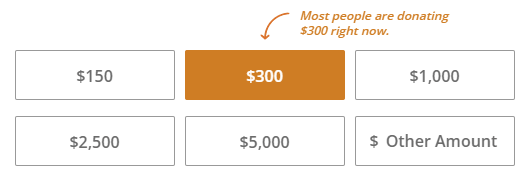
Suggested donation amounts on the CARE donation form. The $300 donation amount is highlighted with a note saying “Most people are donating $300 right now.”
  • Increase involvement in giving programs. Supporters may be interested in joining certain giving programs at your organization, like your monthly giving program, but need extra encouragement to get involved. Compile data about current donors to give prospective supporters the additional motivation they need. For instance, you could include a note on your online giving page that says 70% of all your nonprofit’s donors are members of your monthly giving program. 
  • Recruit more advocates. Social proof can also help you recruit more supporters to advocate for your mission, whether through peer-to-peer fundraising, word-of-mouth promotions, or full-fledged advocacy campaigns. For example, you could share that 97% of current donors say they feel more connected to their fellow community members after joining your advocacy program.  

Ultimately, most people just want to feel part of something bigger than themselves, and that motivates many individuals to support nonprofits over the long term. You can inspire greater participation in your programs by enhancing the feeling of community among supporters and using data to demonstrate the power of your donor base. 

3. Develop donor segments for tailored outreach.

In addition to enhancing your stories themselves, the other major way that donor data can support your storytelling efforts is by helping you develop tailored messaging approaches that fit each donor’s unique needs and interests. 

Naturally, different types of stories will resonate with different segments. Determine which stories will resonate with each audience by using donor data to group audience members in a process called segmentation. According to Bloomerang’s donor segmentation guide, this process involves “separating your nonprofit supporters into groups based on common qualities and characteristics they share.” 

To segment donors, you’ll use your nonprofit’s CRM database to filter donors based on certain criteria and create dedicated groups based on the patterns that emerge. For example, segments can be based on:

  • How recently donors started supporting your nonprofit (whether new donors, established donors, or long-time donors) 
  • How frequently donors give (annually, quarterly, monthly, sporadically, etc.) 
  • How much donors give (this could include major, mid-level, and small donors) 
  • What motivates donors to give (whether past involvement as a beneficiary, participation as a volunteer, or a strong personal conviction for your mission) 

After creating these segments, strategize ways to reach out to each group using storytelling techniques that resonate with them. Let’s say you’re creating a storytelling and marketing strategy for an upcoming crowdfunding campaign. You could segment donors based on the reason they give to your nonprofit to send each group stories that resonate with their motivations. 

For instance, donors who give because they’re former beneficiaries would likely be interested in stories about other beneficiaries who you’ve been able to support recently. Donors who also volunteer may respond positively to stories about how donations keep your volunteer program stocked with the resources it needs to be successful. 

Donors will be more likely to give to your upcoming campaign when you make an effort to connect with them using messages that resonate with their values and life experiences. 

Although it may seem like cold, hard data and the emotional beats of nonprofit storytelling would be odds, the truth is they can work together to enhance your organization’s overall marketing approach. Data can help you understand your audience as individuals to craft stories that speak to them on multiple levels. Ultimately, this allows you to grow stronger bonds with existing donors and expand your reach to new audiences. 

Event Networking Made Easy

Event Networking Made Easy

5 Tips to Maximize Connections

Attending a nonprofit event or conference involves more than just learning about your industry or hearing from experts in your field. This in-person experience allows you to form valuable connections with others and build relationships that can propel your career forward.

When your organization hosts this type of event, you’ll want your attendees to get the most out of it as possible. One of the top ways to create value for your attendees and provide a memorable experience is to facilitate networking opportunities.

By prioritizing networking opportunities, you’ll not only help attendees mingle but also achieve a higher return on investment (ROI) due to the increased value you’ll offer event participants. Check out these tips for maximizing attendee connections that your nonprofit can easily implement for your next event.

1. Use Attendee Badges

During the check-in process, you may provide attendee badges to help guests identify each other and capture event analytics using the attached QR codes. These badges are ideal for networking because they allow attendees to easily learn more about each other and engage in conversation.

To enhance their networking capabilities, make sure your badges feature:

  • Your event or nonprofit logo. Your badges should reflect your organization’s branding and reinforce the connection between your event and nonprofit. If your event has a logo of its own, make sure to include it on the badges as well.
  • The attendee’s name. Make it easy for attendees to learn and remember each other’s names by placing them on their badges. Ensure the font size is large enough for attendees to read.
  • The attendee’s role. Including each attendee’s job title and organization on their badges can break the ice during networking conversations. For instance, if two attendees find that they are both volunteer coordinators or work for animal-related nonprofits, that similarity can form the basis of their connection.
  • QR code. Use badge QR codes to scan attendees into specific speaker or networking sessions. Afterward, you can use your event management platform to analyze the resulting data and determine which opportunities were most popular.

Additionally, your badges should feature an eye-catching design that matches your event or nonprofit’s branding to add consistency throughout your event.

2. Offer Designated Networking Areas

Sometimes, the largest barrier to event networking is the lack of a quiet, uncrowded space to meet with fellow attendees and engage in conversation. To solve this problem, consider sectioning off specific areas of your event venue intended for networking. 

Examples of potential networking areas include:

  • Lounges with comfortable seating and a relaxed atmosphere
  • Networking zones with high-top tables
  • Coffee and refreshment stations
  • Outdoor spaces like patios or courtyards
  • Private meeting or conference rooms

No matter what your networking areas look like, they should be accessible and conducive to conversation. Remember to keep potential networking spaces in mind when choosing a venue to ensure your attendees have ample room to meet and chat with each other.

3. Enable Appointment Booking

When looking for the right event or conference app, there are many considerations to keep in mind. The platform you select should support your goals and be easy for attendees, sponsors, and staff members alike to use.

If networking is a top priority for your team, seek out an app that supports appointment booking. Here’s an example of what the attendee networking process may look like with appointment booking:

  1. Attendees create profiles within your event app that contain their name, contact information, and employment information.
  2. An attendee named Brian Daniels briefly meets another attendee named Ella Smith in between speaker sessions. They soon realize they are both board members of environmental organizations and would benefit from meeting to discuss their roles.
  3. Later in the day, Brian searches for Ella’s profile within the event app.
  4. Brian requests to schedule a meeting with Ella through the app.
  5. Ella receives a notification and accepts Brian’s invitation.
  6. Brian and Ella meet in a networking area of the venue and exchange ideas.

What makes the appointment booking feature so integral to event networking is its ability to streamline networking communications and spark further collaboration. While Brian and Ella met in person during the event, they quickly got wrapped up in the day’s agenda and didn’t get a chance to have a proper conversation at the time. With appointment booking, they had the opportunity to choose a time during the event that they could both dedicate to fostering a connection and easily set up a meeting.

4. Create a Networking Challenge

In the event world, there are tried and true ways to engage attendees, from hosting raffles to creating interactive booths. However, one of the most impactful methods for grabbing attendees’ attention is gamification.

Gamification involves incorporating game-like elements and challenges into your event to generate excitement and develop healthy competition among attendees. The challenges you create may use points, leaderboards, and prizes and will depend on your event’s specific goals.

To encourage networking, try creating a challenge in which attendees earn points for each new connection they form or appointment they book at your event. At the end of the event, grant the attendee who earned the most points a prize like branded merchandise or free admission to your next event.

EventMobi’s event gamification guide discusses how real companies and organizations have used gamification to successfully fuel their own networking goals. Specifically, they mention how TD Bank developed a networking game for their Diversity & Inclusion Event that kept attendees engaged and excited about the experience.

5. Provide Post-event Networking Opportunities

Networking doesn’t have to end when your event does. Help your attendees build upon the relationships they formed at your event by providing post-event networking opportunities.

For example, eCardWidget’s work eCard software guide explains how you can use eCards to encourage attendee connections. Attendees can make interactive eCards branded to your organization and send them to fellow attendees they met at your event, thanking them for their time, inviting them to connect on LinkedIn, or setting up another meeting.

You can also help attendees form new connections through your event platform by opening up the activity feed to attendee submissions even after the event has ended. Guests can post their images, thoughts, and reactions to the event and interact with each other’s content. Then, they can click on the profiles of fellow attendees and network with them.

Networking opportunities can be a big selling point that draws attendees in and encourages them to sign up for your event. Promote your networking offerings in your marketing materials, and emphasize how attending your event will help attendees forge valuable connections.

What the Liberals Don’t Understand About Conservatives

Avoiding Perspective Bias by Connecting With People’s Identities

It’s a constant refrain: this is the most consequential election ever. Democratic pundits are getting their knickers in a twist about a possible Trump victory and the ostensible devastation that it will bring. “We must win. Biden is doing a great job — if only more people knew about his accomplishments, they would vote for him.”

But does this argument hold?

Some polls show that this knowledge will persuade some people. But knowledge has not moved people when it comes to taking vaccines. Or on climate change. Or on the claims of a stolen election. Why would more facts make a difference now?

The liberal argument suffers from perspective bias.

Fundamental differences exist between the ways liberals and conservatives see the world, and using one perspective (a fact-based approach) to try to convince the other party is not an effective solution. 

This deficit of insight is critical. Despite the huge bifurcation of the electorate, persuadable voters are out there and can be reached if their motivations are understood.

To effectively communicate with Republicans or Independent voters (or any marketing audience), perspective bias must be overcome. Arguments must be crafted around other people’s worldviews, values, and identities. Failure to do so risks creating a message that falls on deaf ears or, worse, alienates the intended audience.

So, what are the primary ways our perspective can blind us?

The Importance of Identity

The great dislocation in this country disproportionately affects lower and middle-income people. While the elites laud globalization for connecting the international economy — lifting millions out of poverty and creating middle classes in India and China — they have not empathized with the people who lost out in this country. And a substantial number of people have been marginalized.

Non-college-educated white men have lost more than jobs. Their very identities are threatened.

These men — most of whom vote — are being left behind in our economy, caught between the changing nature of manufacturing in the United States, the rise of the intelligence workforce, and the specter of AI. But, most importantly, increased diversity in our population removes white men as the dominant cultural force.  They feel that their place in society is being threatened. 

Pulling the rug out from under a significant sector of the population without providing a path to continued cultural relevance? Well, that is not helpful.  

Educated liberals fail to connect with this reality. They make a mistake in thinking that everyone is like them. In fact, only four in 10 Americans ages 25 and older have a bachelor’s degree as of 2021 (although that share has grown over the last decade). According to a Pew Research Center survey in 2021, men said a major reason they have not received a four-year college degree is that they didn’t want to. Men were also more likely to say they didn’t have a four-year degree because they didn’t need more education for the job or career they wanted.

And, in 2021, roughly 62% of people ages 18-24 were not enrolled in college, according to the Census Bureau’s population estimates. That’s about 19.3 million people. These people are not heard or respected by liberals. But Trump is giving them credence, reinforcing their identity, and assuring them that they still matter by promoting a white Christian nationalist agenda.

The Democrats need to realize that If a person’s identity is threatened, they will double down to keep it intact. This is why so many Republican voters stick with Trump. They feel like he sees them and values them in a way liberals don’t. It’s not an easy argument to tell them they are wrong and should be happy to abandon their identity. 

For example, coal miners, whose identity is tied to creating the energy to build this country into the most powerful nation on Earth, will not easily abandon that potent image of themselves just because of climate change. Their sense of purpose and role in this country must be nurtured — not just with skills training for green energy. That’s the mistake that Hillary Clinton made in saying, “We’re going to put a lot of coal miners and coal companies out of business.” It didn’t matter that she also mentioned the millions of dollars going for job training. Who wants to be a trainee again instead of a part of a proud legacy?

Bridging the gap between liberals and conservatives requires acknowledging and understanding the diverse perspectives that shape political beliefs. Merely bombarding individuals with facts overlooks the fundamental worldview and identity differences underpinning their allegiances.

Whether coal miners clinging to a sense of purpose or disenfranchised voters seeking validation, the path forward lies in acknowledging and respecting diverse identities. Only by transcending perspective bias can we hope to foster genuine dialogue and enact meaningful change that resonates across the political spectrum.

Need help framing your message in a way that engages your audience?

COVID-19 Messaging Lessons

Health authorities have been telling people to social distance and wear masks. Not everyone is adhering to the recommendations. Let’s take a look at the problems, what could have been done differently — and what you can do to craft persuasive messages that get people to take action.

Continue reading

It’s Time to Rethink Your Purpose

There’s a fundamental shift happening in society.  The challenges are larger than ever, and bigger, bolder solutions are needed to address them.  Nonprofits can rise to the challenge if they rethink their purpose.

Continue reading

The New Nonprofit Normal

The pandemic has forced nonprofits to innovate, and those innovations may change the future of the sector. As a lesson for all nonprofits, here’s what’s happening in New York City.

Continue reading